Introduction
In evaluating Nanaimo’s work on blueways and greenways, one must take into account that it has a population a sixth the size of Vancouver’s and has fewer resources to work with. However, like Vancouver, it is equipped with a strong policy framework, including an official community plan less than four years old – Nanaimo Reimagined1 – that advances high environmental and social aspirations based on the ‘Doughnut Economics’ framework developed by British economist, Kate Raworth2. This framework seeks to balance ecological limits to growth with meeting vital human needs.
Water-Related Activities
To date Nanaimo has conducted a study, in partnership with the Municipal Natural Assets Initiative3, on the value of Buttertubs Marsh4 as a stormwater catchment area5. Moreover, it has enacted a policy with all new developments that a 30-meter setback must be put in place (to protect riparian areas) for all significant fish-bearing streams, with lesser setbacks from other waterbodies. The 30-metre measure is from the streambank, whereas the province measures it from the centre of the stream, making the City’s regulation more strict6. Its work on streams has also involved recruiting the Mount Arrowsmith Biosphere Region Research Institute (MABRRI) to conduct an Ecological Accounting Process analysis of two creeks in the city to provide it and adjacent homeowners with the knowledge to maintain the creeks and their adjacent riparian areas in good condition7.
With the Millstone River in Bowen Park, it partnered with the Department of Fisheries and Oceans (DFO), Vancouver Island University, and stewardship groups to create more favourable conditions for salmon to migrate upstream to spawn8.
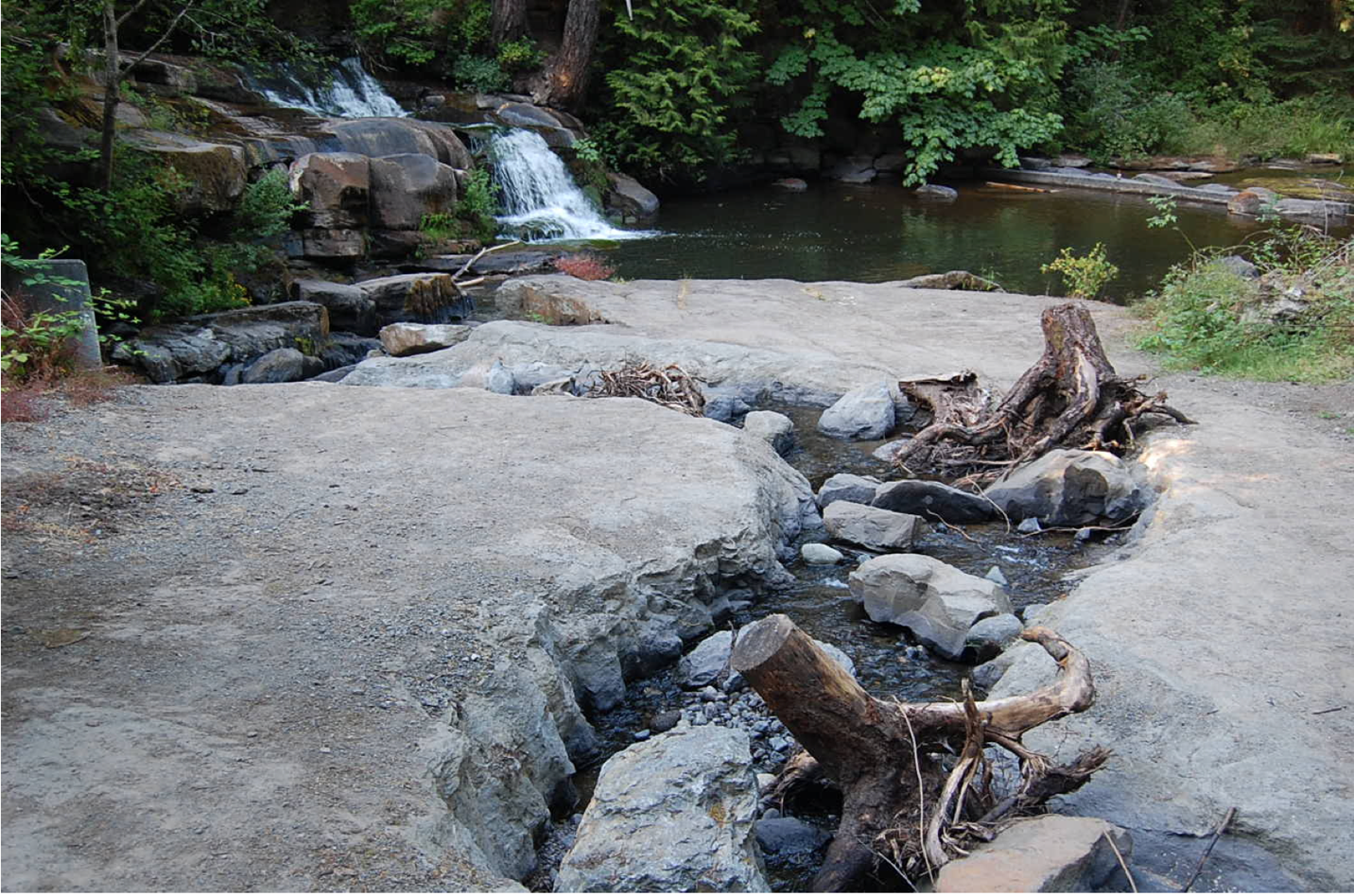 Salmon channel on the Millstone River in Bowen Park (DFO)
It has also worked on one ‘Green Shores’ project to naturalize an ocean shoreline in partnership with a property owner whose land is adjacent to the city’s popular Piper’s Lagoon Park. The Green Shores program involves replacing hard armoring to protect against storm surges and sea-level rise with natural shore treatments that are also habitat-friendly9. Also within the city limits is the Nanaimo River Estuary which has been undergoing extensive restoration work for a number of years10.
Terrestrial Initiatives
The City Plan is less than four years old, and much of its content has yet to be transferred into the older Zoning Bylaw which governs day-to-day land use planning decisions. Nonetheless, it has much to say about ecosystem enhancement. Even before the new City Plan, the city was working on several initiatives, which are ongoing. These include working with community groups on establishing food forests11, Indigenous plant gardens (involving native food and medicine plants) and conducting tree-planting. The city has also been providing grants to community groups for sustainability and watershed projects12.
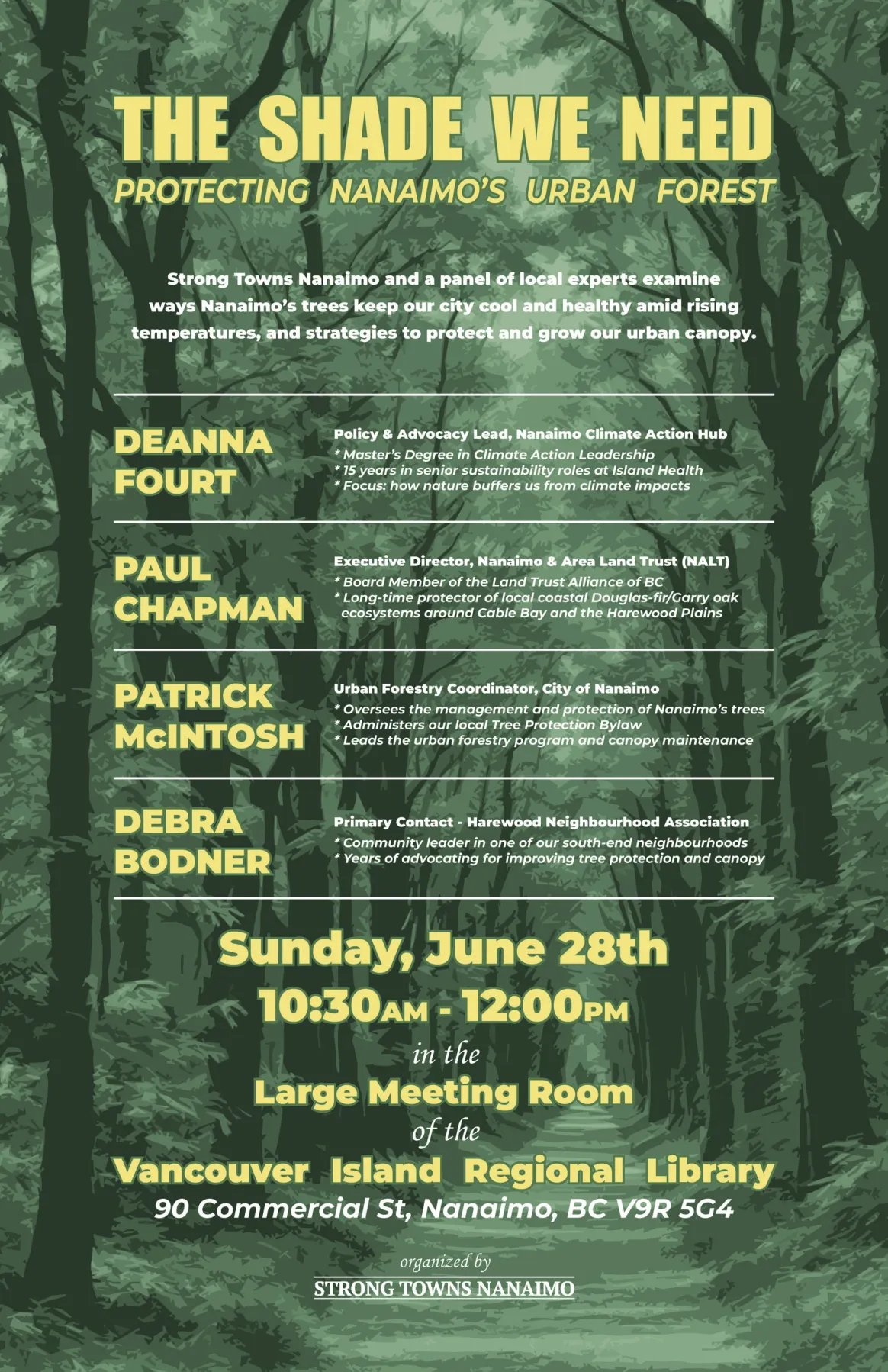
Like Vancouver, Nanaimo is committed to increasing its tree canopy, but has a head start with an average of 33% coverage whereas Vancouver is hoping to have 30% by 2050. Like Vancouver, it is identifying tree-deficient neighbourhoods as a prelude to equalizing canopy coverage. It also has a tree voucher program to reduce the cost of purchasing trees for homeowners13. However, its tree-cutting bylaw currently does not offer sufficient protection for existing trees being removed without just cause14.
Finally, the city is exploring possible greenway links between existing city parks and habitat nodes. One type would primarily be for their wildlife corridor and habitat value and the other would mainly be for recreational purposes15. The latter type ties in with the city’s commitment to promoting more active transportation, which it has been doing through the construction of bike lanes in different parts of the city.
In addition to these focus areas, Nanaimo has produced two crucial documents to accompany the community plan – an Integrated Action Plan, approved by Council in June 2023, and a draft Monitoring Strategy (2024)16. Of the 1000 possible actions flowing from the Community Plan, City Council has identified 203 as being of higher priority. The Draft Monitoring Strategy will enable the city to track its ongoing performance in implementing priority actions against desired targets. To date, 10 of the 23 key indicators identified have been developed17.
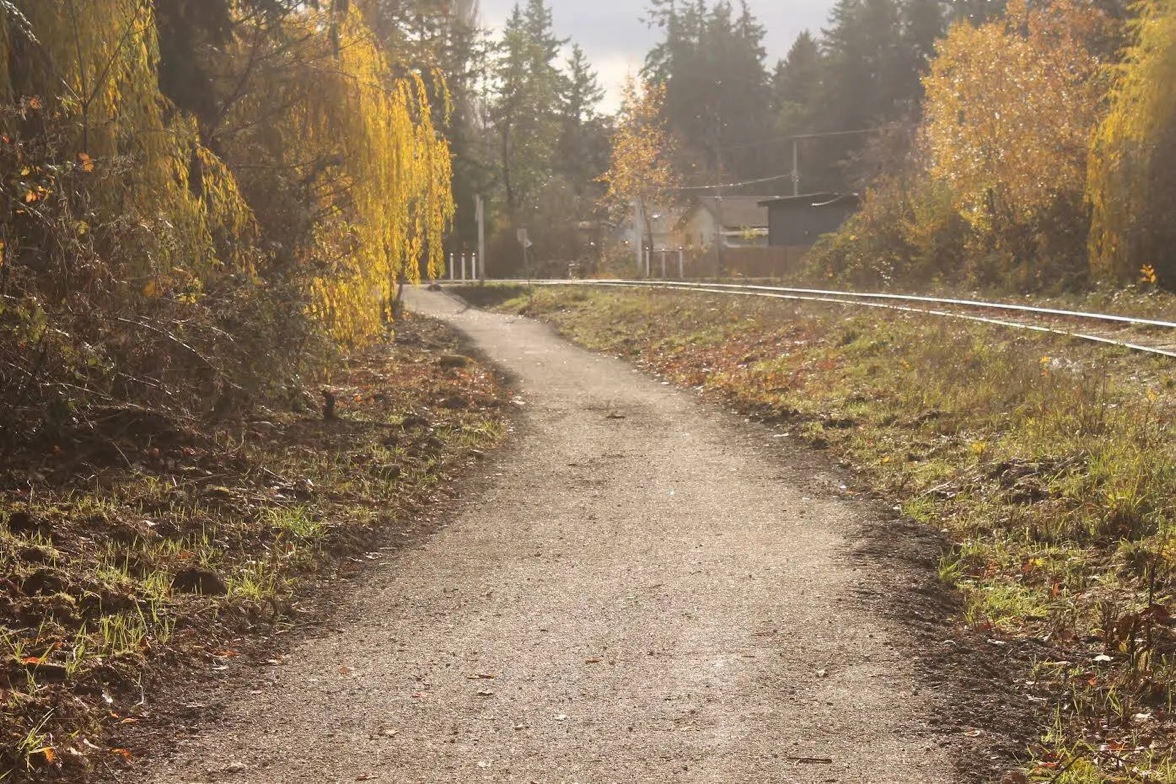 New Rail Path to 7th Street (Nanaimo News-Bulletin)
On the whole, Nanaimo, like Vancouver, has a robust policy framework. However, its implementation of that policy on the ground is still limited; Vancouver, with its greater resources, is much further ahead. Building an extensive network of greenways, both for habitat and recreation/active transportation – linking existing parks and green spaces – could offer major gains with many side benefits. Recently, the city, in partnership with the Island Corridor Foundation and Southern Rail, built a new Rail Path extending from Kennedy and Hecate Streets to 5th and, beyond, to 7th Street. Potentially, it may be extended as far as the Chase River in the future18. Currently, a main priority is developing a plan for, and creating new trails, in the Linley Valley/ Cottle Lake Park area, which is a virtual wilderness in the heart of the city19.
One area that merits attention is providing greater protection to the city’s Garry Oak ecosystems. According to Hunter Jarrett, local invasive and ecosystem restoration expert, the city has lost a number of such ecosystems in recent years and others are at risk20. Fortunately, in addition to dedicated sustainability and parks and rec planners, Nanaimo is blessed with having knowledgeable, active stewardship groups, such as the Nanaimo & Area Land Trust (NALT)21, which have contributed significantly to the city’s ongoing evolution towards sustainability. Hopefully, we will see major things accomplished in the next few years. Ongoing progress will depend on maintaining a progressive City Council.
-
https://www.nanaimo.ca/docs/city-plan-documents/city-plan/city-plan—low-resolution-2022-jul-04.pdf ↩
-
https://www.douglasmagazine.com/nanaimo-is-facing-the-challenges-of-growth-with-a-radical-new-approach-called-doughnut-economics/ ↩
-
Cunningham, T. (2018, 19 April). “Nanaimo adds up the value of natural infrastructure: Environmental assets have dollar value.” Nanaimo News-Bulletin. ↩
-
The monetary value assigned didn’t take into account the marsh’s habitat and recreation value, neither of which are easily monetized, but which are very significant. The Buttertubs Marsh study was one of several pilot projects that co-initiated by MNAI and the David Suzuki Foundation. ↩
-
Stewart, environmental planner, Sustainability Department, City of Nanaimo, personal communication, 5 December 2025. ↩
-
https://rdn.bc.ca/sites/default/files/inline-files/EAP%20French%20Creek%20Final%20Report%20-%20Year%201%20-%202023-2024.pdf ↩
-
[https://rdn.bc.ca/sites/default/files/legacy_asp/dms/documents/dwwp-reports/lantzville-to-south-wellington-water-region/millstone_river_side_channel_project_-2008.pdf](https://rdn.bc.ca/sites/default/files/legacy_asp/dms/documents/dwwp-reports/lantzville-to-south-wellington-water-region/millstone_river_side_channel_project-_2008.pdf) ↩
-
https://stewardshipcentrebc.ca/green-shores-home/gs-about/ ↩
-
https://www.naturetrust.bc.ca/news/nanaimo-river-estuary-restoration-work ↩
-
A food forest is a sustainable, low-maintenance, perennial-based gardening system designed to mimic a natural woodland ecosystem. For more information, see https://projectfoodforest.org/what-is-a-food-forest/. ↩
-
Ting Pan (Manager, Sustainability, Planning and Development, City of Nanaimo) and David Stewart (environmental planner, Sustainability, City of Nanaimo), personal communication (2024, 21 November), and Ting Pan, personal communication, 6 December 2024. ↩
-
The City of Nanaimo’s Tree Voucher Program allows registered property owners to purchase up to two vouchers annually for $25 each, redeemable for a new, city-approved tree valued at up to $90. ↩
-
https://nanaimonewsnow.com/2018/12/09/we-need-to-protect-them-city-pushes-to-improve-nanaimos-tree-canopy/#:~:text=“Well%20treed%20areas%20with%20green%20spaces%20attracts,speculation%20during%20an%20era%20of%20dramatic%20growth ↩
-
Nanaimo Reimagined, (City of Nanaimo, 2022, C1.3.18). ↩
-
https://www.nanaimo.ca/docs/city-plan-documents/integrated-action-plan/integratedactionplan.pdf ↩
-
Pan 2024. ↩
-
Payton Carter, Parks & Open Spaces Planner, Parks & Natural Areas; Parks, Recreation & Culture, City of Nanaimo, personal communication, 9 December 2025. ↩
-
Ibid. ↩
-
Hunter Jarratt, one of two talks sponsored by NALT on February 21, 2026 at a community event, “When Life Gives You Invasives, Make Art.” ↩